Government lays out spending priorities for 2020/21 Fiscal year
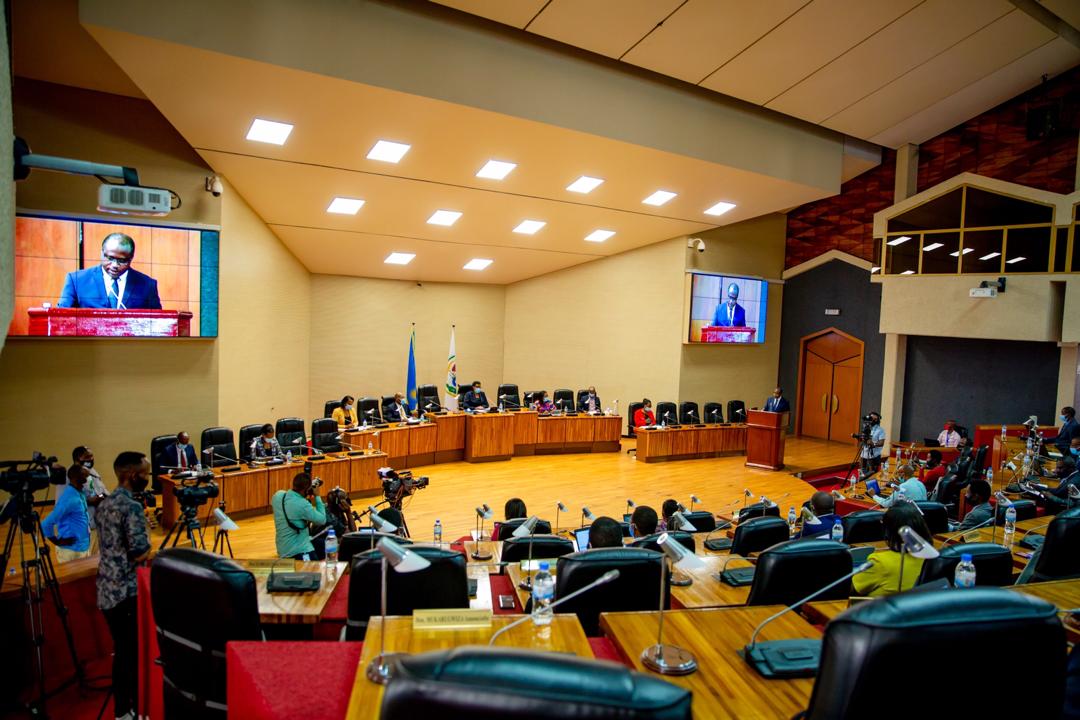
The fiscal policy in 2020/21 will be in line with COVID-19 economic recovery plan and National Strategy for Transformation (NST-1) priorities. Focus will be on increasing health-related spending to contain the epidemic and to strengthen the health system, scaling up social protection, strengthening the education sector, as well as supporting private sector through the Economic Recovery Fund.
Resources The FY 2020-21 budget will be financed through domestic resources worth Frw 1,969.8 billion representing 60.7% of the entire budget. The remainder of the budget will be funded through external sources worth Frw 1,275.9 billion which accounts for 39.3% of the total budget. These include grants worth Frw 492.5 billion and loans worth 783.4 billion.
Expenditure Equally to the projected resources, Government will spend Frw 3,245.7 billion in 2020/21. Recurrent expenditure will take up Frw 1,583.0 billion which accounts for 48.8% of the total budget.
Development projects are projected to consume up to Frw 1,298.5 billion, which represents 40% of the total budget. Domestically financed projects are estimated at Frw 703.4 billion, while externally financed projects are projected at Frw 595.1 billion. In addition, Net Lending has been allocated Frw 306.5 billion which accounts for 9.4% of the total budget. Frw 35.2 billion is allocated to payment of arrears and Frw 22.6 billion reserved for accumulation of deposits to boost the Government reserves representing 1.1% and 0.7% of the total budget respectively.
“The share of recurrent budget in the total budget of 2020/2021 reduced by 2.6% compared to 2019/2020, while development budget and net lending increased by 2.6%. This confirms Government’s effort to contain recurrent expenditures and to focus on development spending,” Dr. Uzziel Ndagijimana, the Minister of Finance and Economic Planning said.
NST-1 and Resources Allocation Government’s expenditure policies in fiscal year 2020/21 are guided by National Strategy for Transformation priorities and objectives while ensuring appropriate allocation by promoting made in Rwanda to reduce trade deficit and build economic resilience. To this end, the Economic Transformation pillar takes the lion’s share of the resources at Frw 1,802 billion amounting to 55.5 % of the total budget. Social transformation will take up Frw 960.4 billion (29.6%) while Transformational Governance is allocated Frw 482.7 billion representing 14.9% of the total budget.
In line with NST-1 strategic objectives, some of the priority areas agreed during planning and budgeting consultations formed the basis for resource allocation in 2020/21fiscal year. These include:
• Strengthening health system by increasing accessibility to quality health services for all
• Increasing agriculture and livestock productivity
• Strengthening Social Protection programs by scaling up coverage.
• Promote employment through investment in public infrastructure.
• Support businesses affected by COVID-19 to recover, boost their business and contribute to the national economic growth.
• Support Made in Rwanda policy to reduce trade deficit and build economic resilience.
• Promote digital infrastructure and technologies to improve service delivery
• Improve access to quality education
• Continue eradication of malnutrition and stunting
• Strengthen disaster preparedness and management
The 2020/2021 draft finance law conforms to the 2020/21 – 2022/23 Budget Framework Paper that was presented to Parliament on May 21, 2020 and amended to reflect the recommended actions by the Parliament as submitted on June 5, 2020.
Topics
Rwanda Hosts ICII 2026 to Expand Inclusive Insurance and Build Resilience
Rwanda is hosting the International Conference on Inclusive Insurance (ICII) 2026 in Kigali, bringing together leaders from the public and private…

Rwanda and IMF Reach Agreement on First Review of Extended Credit Facility Program
Kigali, October 6, 2026 — The Government of Rwanda has concluded discussions with the International Monetary Fund (IMF) on the first review of the…
Rwanda Explores Climate Insurance to Protect Miners and Quarry Workers
Mining and quarrying are one of Rwanda's fastest-growing sectors, employing about 92,000 people in 2025. Yet many workers, especially casual and…

Cabinet Approves Rwanda Development Cooperation Policy 2026–2050
Cabinet has approved the Rwanda Development Cooperation Policy (RDCP) 2026–2050, replacing the Aid Policy of 2006 and reflecting the evolving global…

Rwanda Marks World Population Day
Nyagatare, 17 September 2026 —Rwanda marked the 2026 World Population Day in Nyagatare District, bringing together government representatives, young…

Rwanda’s Economy Grows by 9.4% in Q2 2026
Rwanda’s economy remained resilient in the second quarter of 2026, growing by 9.4% supported by strong performance in industry, services and…

Fitch Reaffirms Rwanda’s ‘B+’ Credit Rating with a Stable Outlook
Rwanda’s creditworthiness remains resilient. Fitch Ratings has reaffirmed Rwanda’s Long-Term Foreign-Currency Issuer Default Rating at ‘B+’, with a…

Rwanda Hosts ESAAMLG Annual Meetings to Strengthen Regional Response to Financial Crime
Kigali, 7 September 2026 – Rwanda hosted the 2026 Annual Meeting of the Eastern and Southern Africa Anti-Money Laundering Group (ESAAMLG), bringing…

Rwanda Closes Dual-Currency EUR/JPY Commercial Loan Facility
Kigali August 26, 2026: The Ministry of Finance and Economic Planning of the Republic of Rwanda (B+/B2/B+) announces the successful closing of a…